
Calm Does Not Always Mean Confident: What New Research Tells Us About Maths Anxiety

Calm Does Not Always Mean Confident:
What New Research Tells Us About Maths Anxiety
When we think of a mathematically confident pupil, we often picture someone who appears calm, answers readily and approaches a task without visible anxiety.
But what if a pupil feels confident because they don’t yet realise that their method is wrong?
Recent research offers an important reminder: the absence of visible anxiety is not necessarily evidence of mathematical understanding. At the same time, carefully designed support can reduce unnecessary anxiety without removing challenge or doing the thinking for the pupil.
Together, these findings strengthen a central principle of Maths Without Fear™:
The goal is not simply to make pupils feel calm. It is to help them develop secure, evidence-based mathematical confidence.
When low anxiety hides a misconception
A study published in October 2026 examined more than 800 pupils in Belgium and Greece as they worked with fractions and decimals.
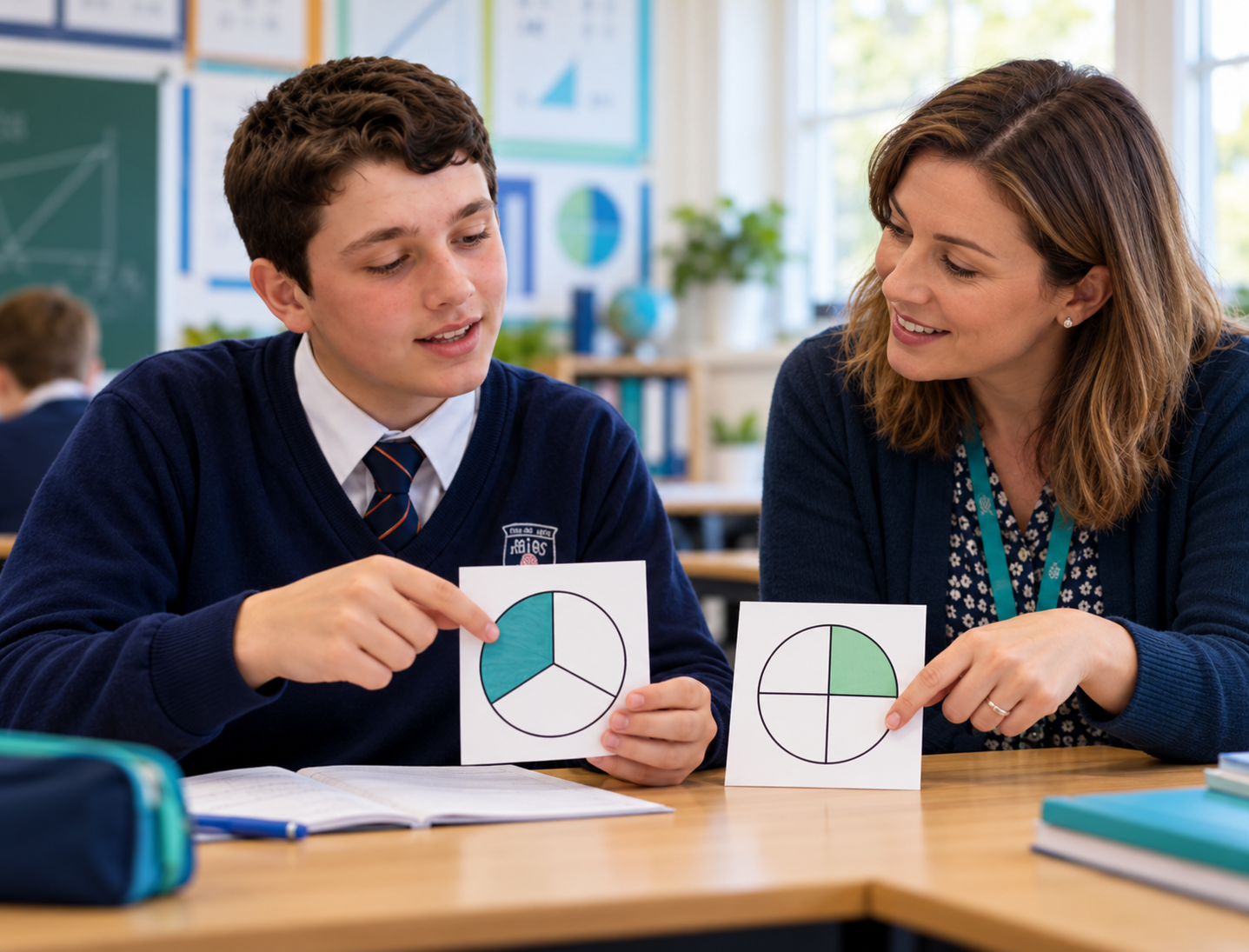
The researchers were particularly interested in pupils who incorrectly applied whole-number rules to rational numbers. For example, a pupil might decide that (1/4) is larger than (1/3) because 4 is larger than 3.
In some of the tasks, pupils who used these systematic but incorrect rules reported less anxiety than other pupils who were performing at a similarly low level.
Why might this happen?
An incorrect rule can still feel familiar, logical and safe. If the pupil does not recognise the conflict between the rule and the mathematics, they may answer confidently and experience very little uncertainty.
This means that a calm or confident response does not tell us whether the pupil truly understands.
It also means that some uncertainty is not necessarily harmful. A pupil who pauses and says, That rule doesn’t seem to work here, may be experiencing a valuable moment of conceptual change.
Teachers therefore need to distinguish between:
Productive security: the pupil is calm because their understanding is secure.
Confident misconception: the pupil confidently applies an incorrect rule.
Productive uncertainty: the pupil recognises that an existing method no longer works.
Threatening struggle: the pupil feels overwhelmed, helpless or afraid of being exposed.
Rather than asking only, Are you confident?, we can ask:
What rule did you use?
Why does your answer make sense?
Would that rule work with this contrasting example?
How could you check your answer?
These questions help us assess the quality of the pupil’s confidence, not simply its appearance.
Support should increase gradually
A second study involved 174 primary-aged pupils randomly assigned to one of three approaches:
AI-supported gamified learning
Gamified learning without AI support
Conventional instruction
Both gamified approaches produced stronger attainment than conventional instruction. However, the AI-supported programme produced additional reductions in maths anxiety and improvements in motivation.
The most useful lesson is not that every school needs an AI learning companion. It is the way in which support was structured.
Instead of immediately supplying an answer, the system gradually increased the level of help:
Orient: direct the pupil’s attention towards the important information.
Reason: prompt the pupil to identify the relevant relationship or mathematical rule.
Model: provide a worked example or clearer demonstration when lighter prompts are not enough.
This preserves an opportunity for the pupil to think independently while ensuring that struggle does not become prolonged, confusing or threatening.
It closely reflects the Maths Without Fear™ principle:
Give enough support to create success, then gradually step back.
The study was short, lasting only two weeks, so its findings should not be overstated. It also cannot tell us which individual feature produced the emotional benefits. Nevertheless, its support sequence offers a practical model that teachers can use without any technology.
What does this mean for classroom practice?
These studies suggest that supportive mathematics teaching requires more than reassurance.
A pupil may need help to feel safe enough to participate, but they also need opportunities to explain, test and refine their thinking. Confidence becomes believable when it is supported by genuine evidence of growing competence.
A useful classroom routine is:
Answer → explain the rule → rate your certainty → test the rule with a contrasting example.
This routine helps teachers uncover misconceptions while showing pupils that uncertainty is not failure. It is information that can guide the next step in learning.
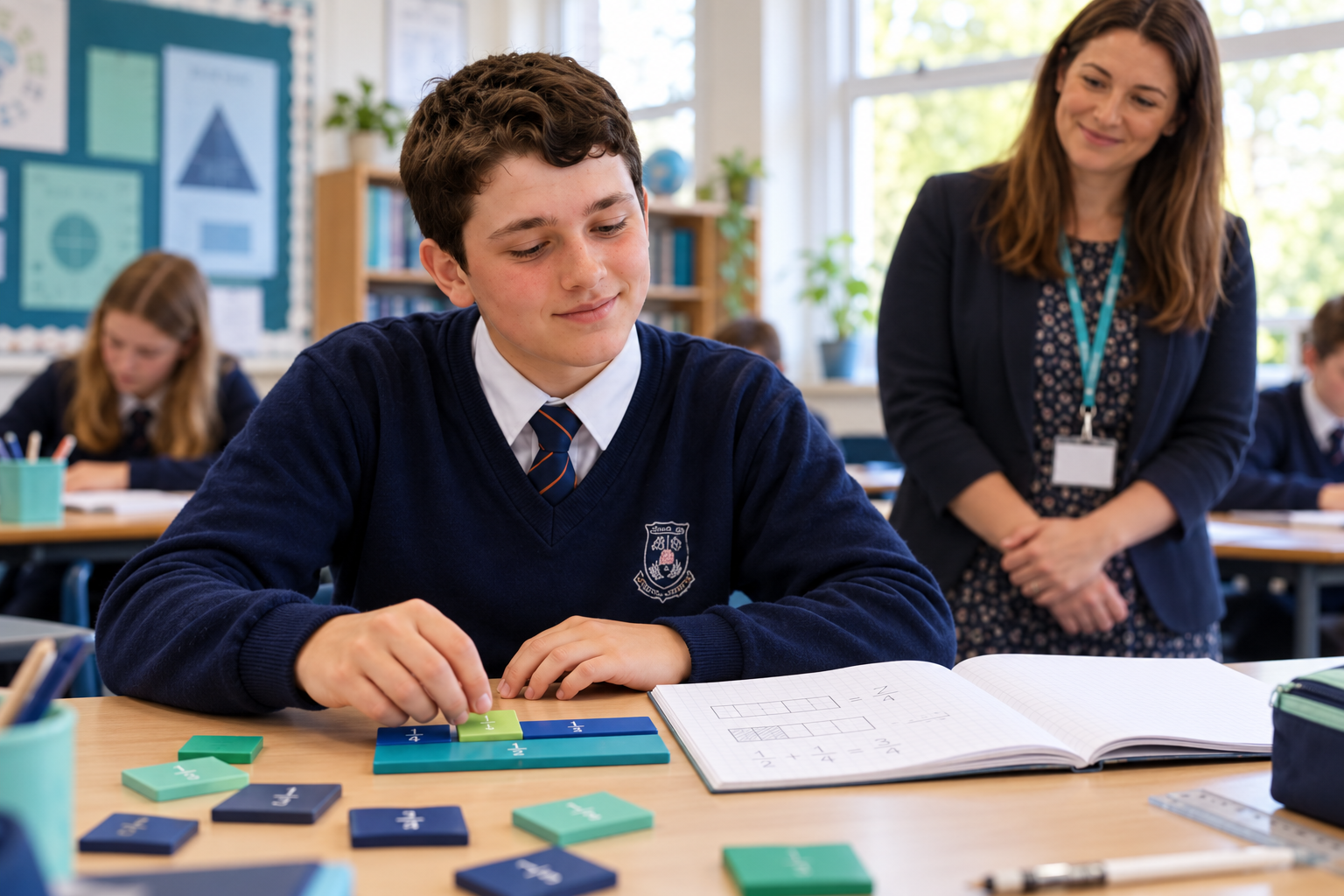
Similarly, when a pupil becomes stuck, teachers can move through a graduated sequence:
Orient → prompt the reasoning → model only when necessary → return the thinking to the pupil.
The Maths Without Fear™ message
Reducing maths anxiety does not mean removing all challenge, preventing every mistake or ensuring that pupils always feel comfortable.
It means removing unnecessary threat while preserving the thinking, reasoning and practice through which real confidence develops.
Within the CALM Framework™, we can:
Connect so the pupil feels safe enough to engage.
Assess both the emotional response and the mathematical understanding.
Lower the Load by reducing unnecessary pressure and providing carefully graduated support.
Motivate by helping the pupil recognise genuine progress and increasing independence.
Ultimately, Maths Without Fear™ should not pursue confidence as a performance or the absence of visible anxiety.
It should help pupils build confidence that can answer a much more important question:
What evidence do I have that my mathematical thinking is becoming more secure?