
5 Mindful Strategies to Help Anxious Teens Get Out of Their Head and Into Their Body
5 Mindful Strategies to Help Anxious Teens Get Out of Their Head and Into Their Body
What if something goes wrong?
What if I can't do it?
What if everyone is judging me?
What if I fail?
For an anxious teenager, it can sometimes feel as though their mind simply won't switch off.
One thought leads to another. They replay conversations, imagine what might happen tomorrow, worry about school, friendships or exams, and become caught in an exhausting cycle of what if?
And sometimes, the more we tell a young person to stop worrying, the more they seem to worry.
That's because when anxiety takes over, trying to think our way out of it isn't always the most helpful place to start.
Sometimes we need to move attention away from the noise in our head and reconnect with what's happening right here, right now, in the body.
Here are five simple strategies that can help.

1. Ground Your Senses
When the mind is racing into the future, the senses can bring attention back to the present.
Ask your teen to pause and notice:
5 things they can see
4 things they can feel
3 things they can hear
2 things they can smell
1 thing they can taste
There's no need to rush.
The idea isn't to get the exercise right. It's simply to notice what's actually happening around them rather than becoming completely absorbed in what's happening inside their thoughts.
You can make it even simpler by asking:
What can you see right now?
What can you hear?
What can you feel underneath your feet?
The present moment gives an anxious mind somewhere else to place its attention
2. Feel Your Feet
This is one of the simplest strategies because your teenager can use it almost anywhere without anyone else knowing.
Invite them to place both feet firmly on the floor.
Then notice the sensation.
Where is the pressure?
Can they feel their heels?
Their toes?
The floor underneath their shoes?
They can gently press their feet into the ground for a few seconds, release, and repeat.
You might simply say:
Don't try to get rid of the thought. Just bring your attention down to your feet.
That distinction matters.
We're not fighting the anxious thought.
We're changing where attention goes.
This can be particularly useful before an exam, presentation, difficult conversation or any situation where anxiety begins to build.
3. Move the Anxiety
Anxiety doesn't only happen in our thoughts.
We can feel it in the body too.
A tight jaw.
Raised shoulders.
Butterflies in the stomach.
Restless legs.
Clenched hands.
A feeling that we simply can't sit still.
Instead of always trying to suppress that energy, sometimes it can help to move the body.
Try:
a brisk walk
stretching
shaking out the hands and arms
dancing to one favourite song
walking up and down the stairs
a few gentle yoga movements
stepping outside for some fresh air
It doesn't need to be a workout.
Even a couple of minutes of movement can interrupt the cycle of sitting still while anxious thoughts become louder and louder.
Sometimes the body needs an opportunity to move before the mind is ready to settle.
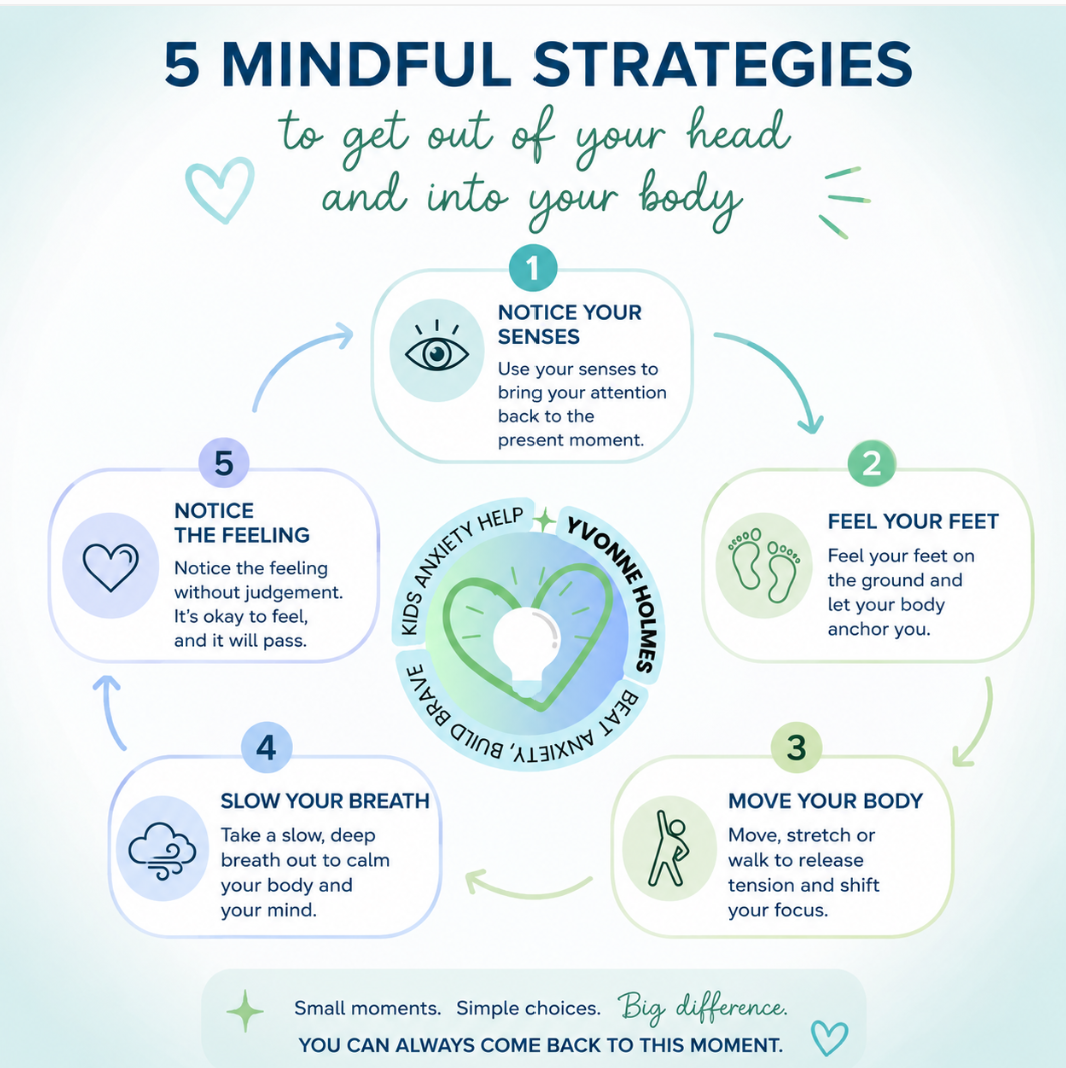
4. Try a Longer, Slower Out-Breath
When a teenager is anxious, telling them to take a deep breath can sometimes become another instruction they feel they're getting wrong.
Keep it simple.
Invite them to breathe in gently through their nose.
Then allow the breath to leave slowly and comfortably.
No huge breaths.
No forcing.
Just:
Gentle breath in.
Slow breath out.
They could imagine they're slowly blowing through a straw or gently cooling a hot drink.
Repeat a few times and notice what happens in the body.
Perhaps the shoulders lower slightly.
The jaw softens.
The hands unclench.
Again, we're not demanding that anxiety disappear.
We're simply giving the body an opportunity to settle.
5. Notice the Feeling Without Becoming the Feeling
When anxiety is strong, a young person might say:
I'm anxious.
But there's a subtle shift we can help them make:
I'm noticing anxiety.
Or:
I'm noticing a tight feeling in my stomach.
Then become curious about it.
Where exactly do you feel it?
Is it tight, heavy, fluttery, warm or cold?
Does it stay in one place?
Does it change when you move?
Can you notice it without immediately needing to make it disappear?
This helps create a little distance between the young person and the feeling.
They are experiencing anxiety.
Anxiety isn't who they are.
Feelings change.
Thoughts change.
And they don't have to respond to every anxious thought as though it's a fact.
You Don't Have to Fight Every Thought
One of the most useful things we can teach an anxious teenager is that they don't have to win an argument with every thought that enters their mind.
A thought can simply be a thought.
Instead of:
How do I make this thought go away?
we can help them ask:
Where can I put my attention right now?
My feet.
My breathing.
Anywhere in my body where I don’t feel anxiety.
The sounds around me.
The movement of my body.
What I can see.
What I'm doing in this moment.
That is the shift from being completely caught up in the mind to reconnecting with the body and the present moment.
Don't Introduce All Five at Once
If your teenager is anxious, handing them a list of five things they should be doing can quickly become another source of pressure.
Instead, choose one.
Try it when they're relatively calm.
Let them decide whether they like it.
If they don't, try another.
Different strategies work for different people.
The aim is to help your teenager gradually build their own toolbox of strategies so that when anxiety appears, they have something familiar they can reach for.
A Note for Parents
When your teenager is overwhelmed, you don't always need to have the perfect words.
Sometimes instead of asking:
What's wrong?
or
Why are you anxious?
try gently bringing their attention to the present:
Can you feel your feet on the floor?
Come outside with me for five minutes.
Where are you feeling this in your body?
Let's slow everything down for a moment.
You don't have to solve everything there and then.
Sometimes helping a young person reconnect with the present moment is enough for the next step to become clearer.
They can do this by saying to themselves:
I am safe in this moment.
One Small Step
The next time your teenager becomes caught in anxious thoughts, remember:
We don't always have to think our way out of anxiety.
Sometimes we can begin with the body.
Feel the feet.
Notice the senses.
Move.
Slow the breath.
Notice the feeling.
Then take the next small step.
Need Support?
Kids Anxiety Help provides practical tools and resources to help children and young people understand anxiety, develop confidence and build emotional wellbeing.
If anxiety is persistent, significantly affecting your teenager's everyday life, or you're concerned about their wellbeing, seek advice from an appropriate healthcare or mental health professional.
Explore more practical resources and support through Kids Anxiety Help.
Yvonne Holmes
Teacher | Counsellor | NLP Practitioner | Clinical Hypnotherapist | Author
Kids Anxiety Help